
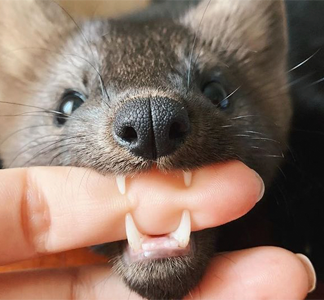
The sable is a predatory animal that feeds on various rodents, pikas, shrews, grouse, capercaillies, small birds, and sometimes insects. If there is absolutely nothing to eat, it hunts squirrels, rabbits, or musk deer. At the same time, the sable also needs plant-based food. Various taiga berries and pine nuts often serve this role. The animal loves to feast on honey. Some individuals occasionally approach hives of wild bees, killing them all for the honeycomb.
If someone is trying to tame a sable, honey is the perfect lure. At home, you can feed the animals a special meat-and-porridge mixture. Grind rabbit or chicken meat through a meat grinder. It is important to serve it raw—if you want to boil it, do so for no more than a couple of minutes. A mandatory step is grinding. Bones should not be removed, except for tubular ones. The next stage is adding beef and offal (liver, heart), as well as fish! Roughly speaking, the ratio should be 30% fish, 30% meat, 30% porridge, and 10% vegetables. You can also add cottage cheese and fruits. Vitamin and mineral supplements are also necessary.
Place the prepared mixture in the freezer and defrost it when it's time to feed. Sables love not only the meat-and-porridge mixture but also treats like rodents and chicks. They won't refuse vegetables, dairy products, various fruits, or eggs (chicken or quail)—but don't overdo the eggs (1-2 times a week is enough). Sables also like raw fish, which can be pre-boiled. Fish goes perfectly with the meat-and-porridge mixture. If you don't have fish, use fish oil (a couple of drops per portion is enough) once a day.
Brewer's yeast can be used as a food additive (only boiled for 30 minutes). In summer and autumn, the animals like to "treat themselves" to various berries (blueberries, rowan, grapes). In autumn and winter, they need Korean cedar nuts or dwarf Siberian pine. They eat both the nuts and the shells. Nuts, grapes, and berries can be served as a separate dish. They love to feast on honey and apples, as well as dried bread and crackers, but you definitely shouldn't overdo such treats.
Three Diet Variations for the Sable: Pros, Cons, and Costs
Due to numerous questions and discussions about the proper feeding of sables, we have thoroughly studied this topic and prepared three diet variations. Each has its own features, advantages, and disadvantages.
Option 1. Optimal (but labor-intensive and expensive)
Cost: 10,000–15,000 rubles per month.
Essence: As close to natural nutrition as possible, it meets all the animal's needs without additional vitamin supplements (if conditions are met).
Diet Composition:
- 50% — meat (poultry, rabbit, beef; the more varied, the better);
- 30% — offal, including: 5% liver (preferably chicken), 3–5% fat;
- 20% — necks (chicken, turkey, rabbit; pre-beaten with a hammer or passed through a meat grinder).
Supplements:
- 1 freshly killed mouse or rat (warm) a day or 1 rat every 3 days;
- 1 chicken egg or 3–4 quail eggs a week;
- 1 tsp of honey every 3 days;
- 10–20g of nuts and berries a day;
- 50g of vegetables and fruits a day;
- by autumn — +10g of chicken fat in the mince.
Important! If it is impossible to give offal, stomach, and especially fresh warm mice, you must add a premix at a dosage of 30–50% of the usual norm.
Option 2. Balanced (less labor-intensive and budget-friendly)
Cost: about 3,000 rubles per month.
Essence: Inferior to the first option in terms of health benefits, but easier to implement and significantly cheaper.
Diet Composition: 25% meat, 25% marine fish, 10% unpeeled stomachs, 5% liver, 5% fat, the rest is porridge.
Important! You must add a sable premix in full volume according to the instructions. Mice and chicks are desirable but not mandatory.
Option 3. Dry food (the riskiest)
Cost: about 7,000 rubles per month.
Essence: Convenient, but carries potential risks due to the unknown composition of commercial feeds.
Diet Base: Super-premium dry food (e.g., for large dog breeds; feeds for small breeds are not suitable due to excess fat).
Important! You must add a premix at a dosage of 30% of the usual norm. This option is considered the riskiest.
Important Notes
- Frozen mice and chicks lose more than half of their beneficial properties. When feeding frozen food, you must give vitamins.
- The first option is the best physiologically but requires time and money.
- The second option is a compromise between health benefits and convenience.
- The third option is the simplest, but also the most unpredictable for the animal's health.
The feeding schedule for the animals is twice a day: morning and evening. Young sables (from one month of age) eat up to 5 times a day in small doses, gradually reducing to twice a day by the age of 3 months. You can also use ready-made dry super-premium food (protein from 50% or more), but this is not suitable for the youngest babies. Adults kept in apartments are usually fed dry food plus supplements like cottage cheese, meat, fish, and fruits (no sweets, very fatty/smoked foods, or sausages!).
VERY IMPORTANT!!!
When buying a baby, you must understand that it is small and fragile! In nature, it lives with its mother for up to four or five months. We take it away at 1.5 months so it tames to a human.
Regarding scaring it: Interact quietly, without sudden movements. Never grab it from behind or when sleeping. Let it sniff your hand first. If it panics, press it gently to your chest to prevent biting and let it calm down.
Regarding health and first aid: The sable has excellent immunity but needs specific care:
- Calcium and Vitamin D: Essential for puppies up to one year. 10 drops of Vitamin D per week. B-group vitamins are also necessary throughout life (e.g., Catosal or Gamatonik, 1 ml per week).
- First Aid Kit: Pain or panic can cause fatal convulsions or edema. Keep Corvalol (sedative), Gabapentin (30mg/kg for convulsions), Enterosgel/Smecta (for diarrhea), Vaseline oil (for constipation), No-Shpa (painkiller), Sulfocamphocaine (heart support), and Gamavit (supportive) on hand. Also keep saline and glucose for subcutaneous injection in case of dehydration.
As they grow, their claws become very sharp and grip-prone. Wear long pants and consider accustoming the sable to nail trimming.
WE HAVE A SPECIALLY DEVELOPED PREMIX FOR DOMESTIC SABLES AND A CALMING SUPPLEMENT IN STOCK
Number SAP: RU08587020. Contains Vitamins A (3000 IU), D3 (450 IU), E (105 mg), K3, B-complex, Niacin, Folic acid, Biotin, Benfotiamine, C, organic Calcium, Selenium, Iron, Manganese, Zinc, Copper, Cobalt, Molybdenum, organic Phosphorus, and Antioxidants. Add 10g of premix to the finished feed. Shelf life: 6 months. CONTAINS ALL NECESSARY MINERALS, VITAMINS, AND CALCIUM IN THREE FORMS!!
Introduction to Sable Biology and Breeding
Cage breeding of sables was first developed in the Soviet Union. The sable (Martes zibellina) belongs to the order Carnivora, family Mustelidae. It is a typical taiga animal with an elongated, flexible body, short limbs, and non-retractable claws. Its diet is mixed. Size varies: males reach 46-49 cm and up to 2 kg, females 42-45 cm and 500-600g. Most females reach sexual maturity at 15-16 months and breed until 12-14 years. Average litter size is 3 puppies.
Biological Features of Digestion
The sable's digestive tract is adapted for animal food. The intestines are short (148-170 cm), meaning food passes quickly (undigested remnants appear in 1.5-2 hours, full digestion in 15-30 hours). They lack a cecum, so bacterial digestion of cellulose does not occur, leading to poor digestibility of plant feeds and a constant need for B vitamins. Carbohydrates are digested worse than protein and fat.
Digestibility and Feeding Norms
Sables digest crude protein by 83-87%, fat by 90-95%, and carbohydrates by 70-86%. Boiling worsens meat digestibility but improves grain digestibility.
Norms for medium-sized adults (Females 0.8-1kg, Males 1.2-1.4kg):
- Oct-Jan: Females 350-360 kcal, Males 400-420 kcal. Protein: 9.0g/100kcal.
- Feb: Females 320 kcal, Males 400 kcal. Protein: 9.5g/100kcal.
- Mar: Females 200 kcal, Males 420 kcal. Protein: 10.0g/100kcal.
- Apr-May: Females 500-550 kcal, Males 450 kcal. Protein: 10.0g/100kcal.
- Jun-Jul: Females 350-360 kcal, Males 400-420 kcal. Protein: 9.5g/100kcal.
- Aug-Sep: Females 420-450 kcal, Males 460-490 kcal. Protein: 9.5g/100kcal.
Main Feeds
Meat and By-products: Horse, beef, rabbit, and poultry meat are highly nutritious and usually fed raw. Liver is crucial for vitamins A and B, especially during mating and lactation.
Dry Feeds: Meat-and-bone meal and fish meal (65-70% protein) are excellent protein sources. Silkworm pupae can also be used.
Juicy Feeds: Berries, carrots, and cabbage aid digestion and provide vitamins C, E, and K.
Grains: Oats, corn, and wheat bran provide energy (carbohydrates). Legumes are strictly forbidden due to the risk of fatal bloating (tympanite).
Dairy and Eggs: Milk, cottage cheese, and boiled eggs are highly digestible. Raw eggs should be avoided due to avidin.
Feed Ratios and Techniques
A varied diet improves palatability. Raw meat is preferred; boiled meat should not exceed 25%. Sables are extremely sensitive to feed quality. Even slight mold or fermentation can cause fatal tympanite. Feed twice a day (morning and evening). Pregnant/lactating females are fed 3-4 times a day. The feed mixture temperature should be 8-12°C in summer and 15-20°C in winter.
Veterinary Academy Diet (per 100g of feed)
- Metabolic energy: 124 kcal
- Dry matter: 32%, Minerals: 4% (Ca 2%, P 1%)
- Per 100 kcal: Crude protein 15.13g, Fat 5.34g, Carbohydrates 7.61g
- Digestibility: Protein 84.7%, Fat 92.5%, Carbohydrates 58.9%
- Essential amino acids (per 100 kcal): Methionine 310mg, Cystine 160mg, Threonine 450mg, Tryptophan 110mg, Isoleucine 530mg, Leucine 1210mg, Valine 770mg, Phenylalanine 640mg, Tyrosine 410mg, Histidine 380mg.